메인 비주얼
-
KREONET(Korea Research Environment Open NETwork)
KREONET is a high-performance backbone network designed to support the research and education community in Korea. By connecting 18 regional centers across the country, it offers transmission speeds ranging from 200 Gbps to 1.2 Tbps. By linking with domestic and international backbone networks, Internet Exchange nodes (IX), and National Data Exchange nodes (NDex), KREONET provides research network services and internet services to over 200 member institutions.
READ MORE -
KREONet2
By 2025, KREONet2 has established a global 100 Gbps ring connecting Asia (Daejeon, Hong Kong), North America (Seattle, Chicago), Europe (Amsterdam), and Asia (Singapore, Daejeon) to support international research collaboration.
READ MORE -
KREONET NOC
KREONET-NOC has been providing uninterrupted and reliable 24×7×365 services for over 35 years, since the launch of the national science and technology research network project in 1988.
READ MORE -
KAFE(Korea Access Federation)
KAFE is a trust-based global authentication and access management service that allows users to access global research and science technology platforms with a single account.
READ MORE -
Network slicing: VDN
KREONET provides network slicing services based on Virtual Dedicated Network (VDN) system and Wide-area SDN (Software Defined Network) Infrastructure (KREONET-S).
READ MORE -
eduroam
eduroam is a service that allows users to access Wi-Fi at affiliated institutions worldwide with only their institutional authentication information.
READ MORE -
Globus
KREONET provides a software-based data transfer platform service (Globus) that supports high-speed transfer of large-capacity data between collaborative research institutions in the form of SaaS (Software as a Service).
READ MORE -
perfSONAR
KREONET provides a network performance measurement service based on perfSONAR. This service continuously monitors various network performance metrics, helping to proactively detect and resolve network issues.
READ MORE -
NDeX
The KISTI National Data Exchange Node (NDeX) project aims to build infrastructure and operational systems for ultra-high-performance national large-scale data exchange nodes, including development of core technologies(non-blocking optical packet switching, Software data exchange, T&I, operation and management).
READ MORE
-
Infrastructure
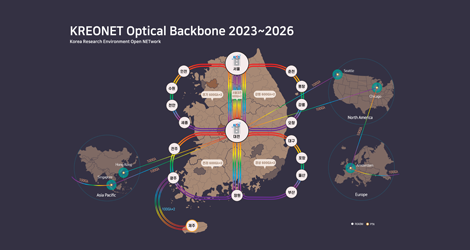
KREONET Optical backbone network
By applying ROADM/PTN-based 600 Gbps (per single lambda) transmission technology, five optical backbone rings were built to connect 18 regional network centers nationwide.
READ MORE -
Infrastructure

KREONET L2/L3 network
By building an L2/L3 backbone network, KREONET provides users with a high-speed network ranging from 1 Gbps to 400 Gbps.
READ MORE -
Infrastructure
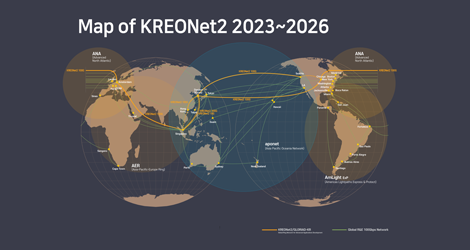
KREONET International network
100 Gbps international backbone circuits: Hong Kong – Daejeon, Singapore – Daejeon, Daejeon – Chicago, Daejeon – Seattle, Chicago – Amsterdam, Amsterdam – Singapore
READ MORE -
Infrastructure
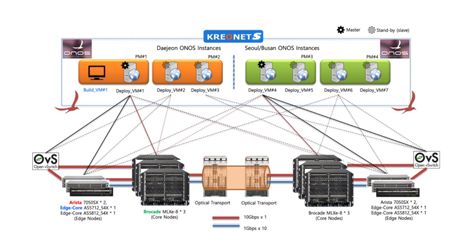
KREONET-S
KREONET-S is Korea's first software-defined wide-area research network, built in 2015 based on KREONET. It was designed and built to implement an end-to-end, on-demand virtualized/intelligent programmable network for advanced and applied research.
READ MORE -
Infrastructure

KREONET-NOC
KREONET-NOC has been providing uninterrupted and reliable 24×7×365 services for over 35 years, since the launch of the national science and technology research network project in 1988.
READ MORE -
R&D

AI Research platform for KREONET
The KREONET AI platform provides researchers with a big data-based AI research environment (virtualized resources such as computing, storage, and distributed computing) utilizing high-speed networks.
READ MORE -
R&D

SCION
SCION (Scalability, Control, and Isolation on Next-generation Networks) is a next-generation internet architecture designed to maximize network availability, usability, and reliability, while significantly enhancing security.
READ MORE -
R&D
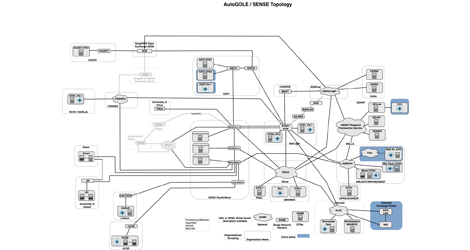
AutoGOLE / SENSE
AutoGOLE, a project under the Global Network Advancement Group (GNA-G), facilitates global collaboration between Open eXchange Points and Research and Education (R&E) networks. SENSE enables multi-domain orchestration of network and cyberinfrastructure resources, integrating beyond-network elements such as computing, storage, and Data Transfer Nodes (DTNs).
READ MORE -
R&D

Intercontinental Optical Clock Comparison
The project integrates the highest-precision time measurement capabilities of optical clocks with the ultra-high spatial resolution of next-generation broadband Very Long Baseline Interferometry (VLBI).
READ MORE -
NDeX

National Data eXchange
The KISTI National Data Exchange Node (NDeX) project aims to build infrastructure and operational systems for ultra-high-performance national large-scale data exchange nodes, including development of core technologies(non-blocking optical packet switching, Software data exchange, T&I, operation and management).
READ MORE
Latest news
LEARN MORE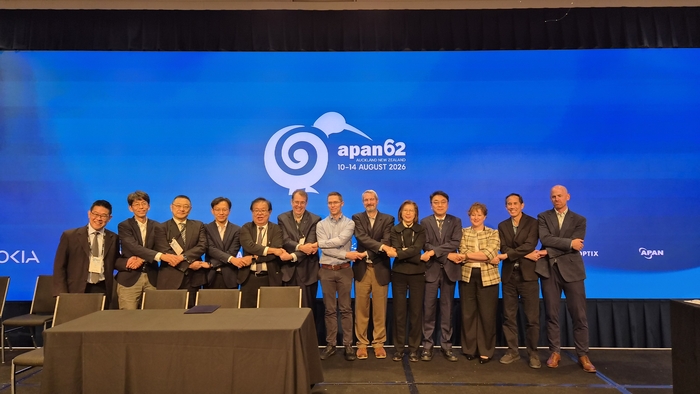
2026.08.19.
KISTI Strengthens APOnet Partnership to Build 400Gbps Global Research NetworkOn August 11, at the 62nd meeting of the Asia Pacific Advanced Network (APAN), KISTI signed a multilateral Memorandum of Understanding with national research network institutions across seven countries: South Korea, the U.S., Japan, Australia, New Zealand, Singapore, and China. This agreement expands and renews the Asia Pacific Oceania Network (APOnet) consortium framework originally established in 2021. 📍Having operated KREONET, Korea's national research network, since 1988, KISTI continues to strengthen international backbone resilience. Through APOnet’s mutual backup architecture, member institutions can significantly reduce operational costs for high-bandwidth backbones while maintaining resilient, world-class service availability. 🌐 The 400Gbps infrastructure will serve as a vital data transmission backbone for global science facilities, including Australia’s Square Kilometre Array (SKA) and CERN’s High-Luminosity Large Hadron Collider (HL-LHC). 🤝 The APOnet includes leading global partners such as Internet2 AARNet (Australia's Academic and Research Network) REANNZ Ltd. SingAREN. Looking ahead, KISTI remains committed to fostering global network partnerships to empower collaborative scientific discovery. 🔎 Find the full article: https://lnkd.in/gGUWghMb 🔎 Learn more about KREONET's international cooperation: https://lnkd.in/gzDUDij5 #KISTI #KREONET #APOnet #ResearchNetwork #AIInfrastructure #InternationalCooperation #APAN62 #APAN